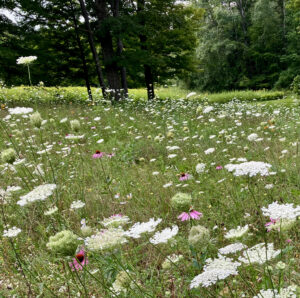
 Ranks of Queen Anne’s Lace have taken over the wildflower field this year — tall, pale, and lithe as ballerinas. This August’s endless rains have brought them to their knees time after time, but by morning they’ve sprung up again — seemingly taller and stronger than ever. Despite the royal title, Queen Anne’s Lace has quite humble origins: it’s actually wild carrot and considered to be edible in its first year of life. Like many wildflowers, it possesses a litany of uses. The Romans ate it as a vegetable and the American Colonists boiled the taproots to make wine. Its sugar content is second only to that of the beet among root vegetables, and it’s been employed as a sweetener in various cultures around the world.
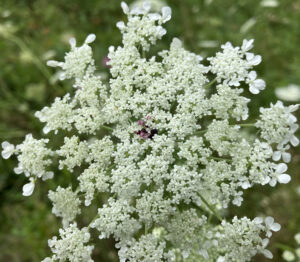 Who was Queen Anne? That’s a matter of some debate. One story claims she was the wife of King James the First of Britain and was known for her needlework. The pinpoint of purply red at the center of each white flower is said to represent the droplet of blood left by the queen when she pricked herself making lace. Another, darker tale, relayed in a recent article in the Berkshire Eagle, identified her as Queen Anne II (1665- 1714), the last of the Stuart monarchs. Over the course of 16 years, this queen was pregnant 17 times, with only one child surviving to the age of 11. Ironic then that the seeds of Queen Anne’s Lace are purported to have contraceptive powers and were used in ancient times to prevent pregnancies. But tug on just about any wildflower and you’ll discover a fascinating tangle of magical properties and old wives’ tales.
Wildflowers
by Reginald Gibbons
Coleridge carefully wrote down a whole page
of them, all beginning with the letter b.
Guidebooks preserve our knowledge
of their hues and shapes, their breeding.
Many poems have made delicate word-chimes—
like wind-chimes not for wind but for the breath of man—
out of their lovely names.
At the edge of the prairie in a cabin
when thunder comes closer to thump the roof hard
a few of them—in a corner, brittle in a dry jar
where a woman’s thoughtful hand left them to fade—
seem to blow with the announcing winds outside
as the rain begins to fall on all their supple kin
of all colors, under a sky of one color, or none.

What a beautiful poem.
I love seeing Queen Anne’s Lace all around Maine. It announces that summer is on the wane, not the rising. I love all the wildflowers….often a yellow, purple and white sight alongside roads .
And the pink cornflowers are in abundance here too.
Always good to hear from you, Cheryl. We also have a lot of echinacea this year — which I love.
Interesting, I love Queen Anne’s Lace!
Thanks for writing, Hannah!
Lovely poem. I love the background stories and find it very interesting. I had Queen Anne’s Lace in my bridal bouquet when Tom and I married 25 years ago. I just love it!
And please send some of your rain to us in south Texas! 😉
Good to hear from you, Jenn. I would happily send you some Berkshire rain — if you could send me some Texas heat!
Just love these stories of the origins of this flower. A reminder of how much came before that enriches what surrounds us.
Every wildflower seems to have a myriad of myths and uses — along with a number of names!
Thank you, Liza, I’ll look at Queen Ann’s Lace with new eyes!
Lorraine
Thanks, Lorraine. So nice to hear from you.
I love learning the origins and myths about flowers.
Thank you for this Liza. So magical!
I can easily imagine you turning Queen Anne’s Lace into one of your wonderful illustrations, Jency.