
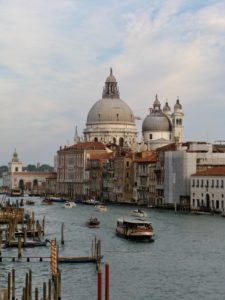
 Venice has been on my mind a lot lately. It’s a city I know well enough to be able to find my way along its cobbled streets and across its marbled bridges with the aid of memory alone. There’s the Rialto rising out of the mist. A vaporetto puttering into its stop in front of the Accademia. We spent many Christmases there — when darkness fell like a velvet curtain and the lights of old palaces glittered in the inky waters. Though outwardly ostentatious and mercenary, Venice has always been a secretive and mysterious place. Many of its most stunning treasures are tucked away in unexpected places: the Carpaccio
 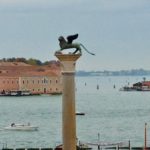 paintings in the tiny Scuolo San Giorgio degli Schiavoni; the tesselated marble floor, rich and intricate as an oriental carpet, mostly overlooked by the hordes being herded through the Basilica di San Marco; the mismatched pride of lions that guard the entrance to the Arsenale. At every turn, Venice is a visual feast, an alchemy of stone and light and water. And now, of course, far too much water.
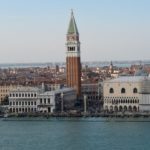 It’s true that La Serenissima has been in decline for centuries. The city’s sense of melancholy has long been part of its exotic charm. Though this time it feels different — more ominous — perhaps because the waters are rising everywhere. Still, I was somewhat heartened to re-read Lord Byron’s famous paeon to the city —written over 200 years ago when the poet was 24 — which bemoans at splendid Byronic length “her day of woe.”
Childe Harold’s Pilgrimage
by Lord Byron
Verses I, XV and XVIII from Canto the Fourth
I stood in Venice, on the Bridge of Sighs;
A palace and a prison on each hand:
I saw from out the wave her structures rise
As from the stroke of the enchanter’s wand:
A thousand years their cloudy wings expand
Around me, and a dying glory smiles
O’er the far times when many a subject land
Looked to the winged Lion’s marble piles,
Where Venice sate in state, throned on her hundred isles!
* * *
Statues of glass—all shivered—the long file
Of her dead doges are declined to dust;
But where they dwelt, the vast and sumptuous pile
Bespeaks the pageant of their splendid trust;
Their sceptre broken, and their sword in rust,
Have yielded to the stranger: empty halls,
Thin streets, and foreign aspects, such as must
Too oft remind her who and what enthrals,
Have flung a desolate cloud o’er Venice’ lovely walls.
* * *
I loved her from my boyhood: she to me
Was as a fairy city of the heart,
Rising like water-columns from the sea,
Of joy the sojourn, and of wealth the mart
And Otway, Radcliffe, Schiller, Shakspeare’s art,
Had stamped her image in me, and e’en so,
Although I found her thus, we did not part,
Perchance e’en dearer in her day of woe,
Than when she was a boast, a marvel, and a show.

A tribute to the power of words, both yours and Lord Byrons. A journey to an incomparable place.
I do love being included in the same sentence with Lord Byron. Thank you!
Guido Brunetti would give you a hug if he met you on the street.
And I’d do a backwards somersault if I met Brunetti on the street!